
What Is VOC in Paint? Guide to Safer, Eco-Friendly Choices


TL;DR:
VOC levels during painting can spike up to 1000 times normal indoor concentrations.
Los Angeles regulates VOCs through Rule 1113, requiring compliance below specific g/L limits.
Using low or zero-VOC paints and proper ventilation reduces health risks and speeds up safe re-entry.
The moment you crack open a can of paint, you are releasing far more than color into your home. Indoor VOC concentrations can spike up to 1,000 times higher during painting projects than normal background levels, making a freshly painted room one of the most polluted spaces in your home. For Los Angeles homeowners and property managers, this is not just an abstract health statistic. LA’s warm climate, dense construction, and strict air quality regulations make VOCs a uniquely pressing concern. This guide breaks down what VOCs are, how local rules apply, what the health stakes really look like, and how to make genuinely safer choices for your next painting project.
Table of Contents
Key Takeaways
Point | Details |
VOCs explained | VOCs are chemicals in paint that escape into the air and can harm your health and the environment. |
LA regulations matter | Strict local VOC limits mean you need to check labels carefully when painting in Los Angeles. |
Healthier paint choices | Switching to low- or zero-VOC paints greatly reduces toxic exposure especially during and right after painting. |
Modern low-VOC performance | Today’s low- and zero-VOC paints offer excellent durability, coverage, and low odor for residential and commercial spaces. |
What are VOCs and why do they matter?
VOCs, or volatile organic compounds, are carbon-containing compounds that evaporate at room temperature, releasing gases into the air you breathe indoors and out. The word “volatile” simply means they turn from liquid to gas quickly. In paint, this happens as the coating dries.
Paints contain a mix of pigments, binders, and solvents. The solvents are the main VOC source. As paint dries, those solvents evaporate. Common culprits found in conventional paints include toluene, xylene, and trichloroethylene. These are not just smells. They are active chemical compounds that linger in your indoor air long after the paint looks and feels dry.
It is not only paint that contributes. Many household products emit VOCs:
Paint thinners and strippers
Adhesives and sealants
Varnishes and lacquers
Cleaning supplies
Pressed wood products
When you combine a fresh paint job with other VOC-emitting products in the same space, the concentration in your air compounds quickly. In Los Angeles, this matters even more because the region’s warm temperatures accelerate off-gassing. Heat speeds up evaporation, meaning VOCs escape faster and in larger quantities during summer months or in sun-exposed rooms.
LA buildings also tend toward tighter construction methods in newer developments, reducing natural air exchange. Less ventilation means VOCs accumulate indoors rather than dispersing.
“The concentration of VOCs indoors can be two to five times higher than outdoor levels under normal conditions, and significantly worse during and after painting.”
If you are weighing your product options, a solid low VOC paint guide can help you understand what separates marketing language from genuine low-emission formulas. Not all paints labeled “low odor” are actually low-VOC, and that distinction makes a real difference for your indoor air quality.
VOC regulations for paints in Los Angeles
With a clear grasp of what VOCs are, it is vital to know how LA regulates them in paints. Los Angeles falls under the jurisdiction of the South Coast Air Quality Management District. Their Rule 1113 sets binding VOC limits for architectural coatings sold and used in the region, including both residential and commercial applications.
These limits are measured in grams of VOC per liter of paint (g/L). Here is what compliance looks like across common paint categories:
Paint Category | Rule 1113 Limit (g/L) | Super-Compliant Threshold (g/L) |
Flat coatings | 50 | Under 10 |
Nonflat coatings | 100 | Under 10 |
Primers and sealers | 100 | Under 10 |
Colorants/tints | 150 | Under 50 |
Meeting Rule 1113 is the legal minimum. But many premium brands now offer products far below those thresholds, sometimes as low as 5 g/L or even zero. For a homeowner, the practical difference between a paint at 90 g/L and one at 5 g/L is significant in terms of air quality and recovery time after painting.
For property managers overseeing commercial spaces, compliance is not optional. Using non-compliant paints in LA County can result in fines and liability. Always check the product data sheet, not just the label claim.
When exploring paint options for your project, ask your contractor to provide the technical data sheet for every product being used. This single document tells you the actual g/L rating, confirming whether a paint is Rule 1113 compliant or better.
Pro Tip: Look for the “Actual VOC” value on a paint’s technical data sheet, not just the product name or “low-VOC” marketing claim. Some products meet Rule 1113 on the base coat but jump in VOC content once colorants are added. Reviewing LA-specific painting safety rules before your project can help you ask the right questions.
Health effects of VOCs in paint
Knowing the legal limits is one thing, but understanding VOCs’ true impact on your health hits even closer to home. The EPA links VOC exposure in paint to a clear range of short and long-term effects, and the research is not reassuring for people spending significant time in freshly painted spaces.
Here is a breakdown of health effects organized by exposure duration:
Eye, nose, and throat irritation (appears within hours of exposure)
Headaches and dizziness (common during and after painting without ventilation)
Nausea and loss of coordination (with high-concentration exposure)
Worsened asthma and allergy symptoms (ongoing low-level exposure)
Liver and kidney stress (documented with prolonged exposure to specific solvents)
Elevated cancer risk (long-term exposure to benzene and formaldehyde in some paints)
According to the EPA, short-term VOC exposure can cause headaches, dizziness, and irritation, while long-term exposure elevates respiratory and cancer risks. These are not edge cases. They are documented effects of products still commonly sold and used across LA.

The 1,000x spike. During active painting, indoor VOC levels can reach 1,000 times the normal background concentration. That number does not return to baseline the moment painting stops. Off-gassing continues for days, weeks, or even months with conventional paint.
Vulnerable groups face the steepest risks. Children’s developing respiratory systems are especially sensitive. Elderly residents, people with existing respiratory conditions, and anyone with chemical sensitivities should not occupy a freshly painted space using conventional paint for at least 48 to 72 hours. For nurseries and pediatric spaces, the stakes are even higher.
Switching to low or zero-VOC paint meaningfully reduces these risks. Studies on reducing VOCs in living spaces show that cutting VOC sources can lower total indoor emissions by up to 70 percent. The eco-friendly painting benefits extend beyond smell. They directly affect how quickly a space becomes safe to inhabit again.
Choosing low and zero-VOC paint: What you need to know
Once you understand the risks, the next question is how to make the smartest clean-air choices for your next project. Not all low-VOC products are equal, and the label alone can mislead you.
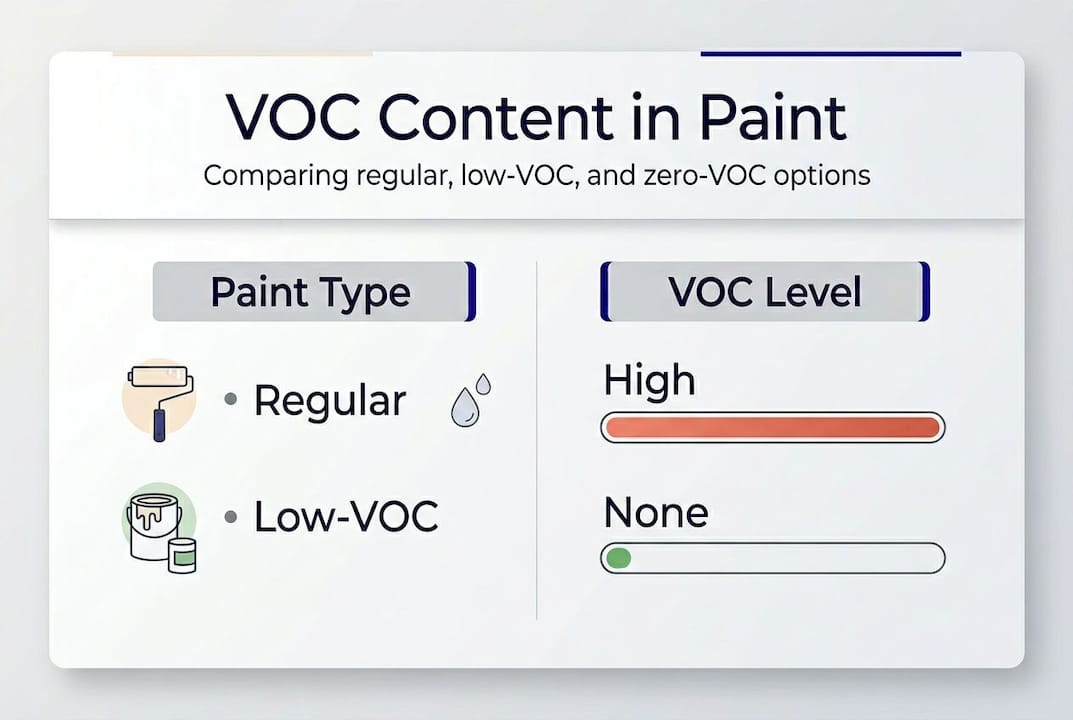
Here is a quick side-by-side comparison of your main paint categories:
Feature | Regular paint | Low-VOC paint | Zero-VOC paint |
VOC content | 150-400 g/L | 5-50 g/L | Under 5 g/L |
Odor during application | Strong | Mild | Minimal |
Off-gassing period | Weeks to months | Days to weeks | 24-72 hours |
Durability (2026 formulas) | Standard | Equal | Equal or better |
Price premium | None | Low | Low to moderate |
As the data shows, modern low and zero-VOC paints perform as well as or better than traditional options, with re-entry times as low as 24 hours. The performance gap that existed ten years ago has largely closed.
When reading labels at the store, watch for these specific terms and thresholds:
Flat coatings: Under 50 g/L to meet Rule 1113, under 10 g/L for super-compliant
Nonflat coatings: Under 100 g/L to comply, under 10 g/L for best air quality
“Zero-VOC”: Legally means under 5 g/L in the untinted base
“Tint safe”: Colorants used are also low-VOC, not just the base
“Actual VOC”: This is the number to compare, found on the technical data sheet
Here is the edge case most homeowners miss. A zero-VOC base paint can jump to 50 g/L or more once a standard colorant is added to tint it. That completely undercuts the low-emission benefit. Ask specifically for zero-VOC colorants and confirm the tinted product’s final VOC rating.
Pro Tip: Request zero-VOC colorants by name when ordering custom colors. Brands like Benjamin Moore Natura and Sherwin-Williams Harmony offer tint systems designed to keep final VOC levels minimal across their color range.
For a deeper look at product selection, understanding low VOC paint labels takes some practice, and knowing applying low-VOC paint best practices ensures you get the clean-air results you are paying for.
The overlooked truth about VOCs in LA painting projects
After working on hundreds of painting projects across Los Angeles, we have seen a pattern. Most clients feel reassured the moment they hear “low-VOC.” They assume the work is done. In reality, that is often just the starting point.
Compliance with Rule 1113 does not guarantee clean indoor air. It guarantees legality. A paint at 95 g/L is technically compliant for nonflat coatings, but it is still releasing substantial VOCs into your home. Many projects we encounter use compliant base coats paired with high-VOC colorants, primers that were not included in the “low-VOC” conversation, or adhesives and caulks nobody thought to check.
The real standard to aim for is super-compliant: under 10 g/L across every product touching your walls, including primers, topcoats, and colorants. This is not the industry default. You have to ask for it.
Re-entry timing is another area where people get shortchanged. A painter may say the room is ready in two hours because the paint feels dry. Off-gassing and physical dryness are not the same thing. For sensitive individuals, that distinction is the difference between a safe space and a health problem.
Our honest advice: when hiring any contractor, ask them to document the exact brand, product name, lot number, and VOC rating of every material used. Not a marketing summary. A paper record. For guidance on making truly sustainable choices, our sustainable painting guidance goes deeper into what a responsible project looks like from start to finish.
Transform your space with safe, eco-friendly painting professionals
Ready to ensure your next painting project protects everyone’s health as well as your investment? Picking up a can labeled “low-VOC” at the hardware store is a start, but professional application, the right primers, zero-VOC colorants, and proper ventilation protocols are what actually deliver clean indoor air results.

At Johnny’s Custom Painting, we bring over 16 years of Los Angeles experience to every project, from single-room interior refreshes to large-scale commercial spaces. Our team selects products that meet or exceed Rule 1113 and advises clients on re-entry timing and ventilation. Explore our exterior painting services and interior commercial painting work, or reach out directly to your trusted Los Angeles painting contractor for a free consultation tailored to your property.
Frequently asked questions
What are VOCs in paint and why are they harmful?
VOCs in paint are chemicals that vaporize into indoor air, causing short-term symptoms like headaches and irritation, and raising the risk of respiratory and other health problems with prolonged exposure. Even after paint looks dry, these gases can continue off-gassing for weeks.
What is the VOC limit for paint in Los Angeles?
Under South Coast AQMD Rule 1113, flat architectural coatings must stay under 50 g/L VOC and nonflat coatings under 100 g/L. Super-compliant products go well below those thresholds, often under 10 g/L.
Are low-VOC paints as durable as regular paints?
Low-VOC paints now match or exceed traditional formulas in coverage, adhesion, and washability, meaning you do not have to trade performance for cleaner air. The technology has improved dramatically over the past decade.
How long do VOC emissions last after painting?
Zero-VOC paints typically finish off-gassing within 24 to 72 hours, while conventional paints with high solvent content can continue releasing emissions for one to three months after application.
Recommended
Comments