
Insured Painting Contractors: What LA Homeowners Must Know

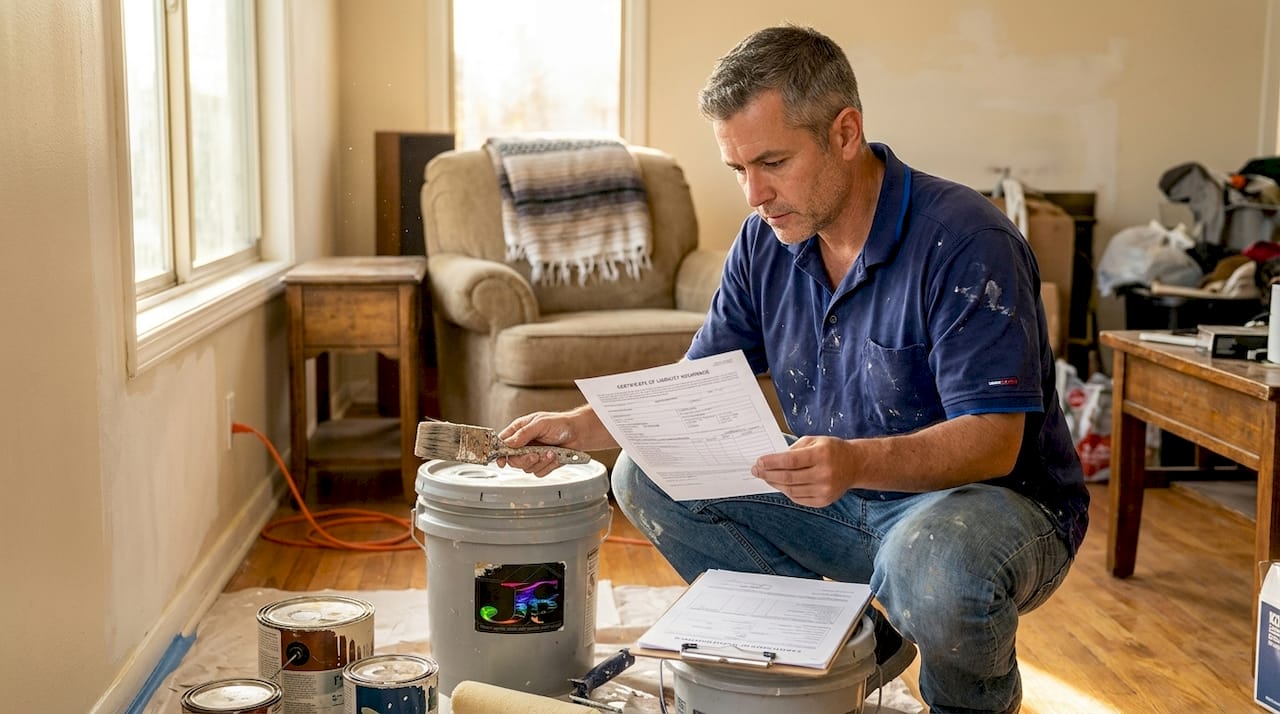
TL;DR:
California law mandates licensed contractors over $500 to carry specific insurance to protect property owners.
Verifying current insurance through a Certificate of Insurance and CSLB license check is essential before hiring.
Insurance coverage ensures liability protection against property damage, injuries, theft, and legal claims.
Many Los Angeles property owners treat contractor insurance as a bonus feature, like a warranty upgrade they can skip to save money. That assumption is wrong and potentially very costly. California law requires licensed painting contractors to carry specific insurance policies, and any job over $500 requires both a license and proof of coverage. Hiring an uninsured crew does not just put your property at risk. It can make you personally liable for injuries, damage claims, and regulatory fines. This guide explains exactly what insured means, which policies matter, and how to verify coverage before a single drop of paint touches your walls.
Table of Contents
Key Takeaways
Point | Details |
Insurance is essential | All reputable LA painting contractors must have proper insurance to protect clients and meet legal requirements. |
Check proof of coverage | Always demand a current Certificate of Insurance naming you as additional insured before any work begins. |
Risks of uninsured hires | Hiring uninsured painters exposes you to lawsuits, costly claims, and project delays—or worse. |
Special situations need scrutiny | Lead paint, high-rise, and commercial jobs require extra insurance and certifications you should verify up front. |
What does it mean to be an insured painting contractor?
The phrase “insured painting contractor” gets thrown around a lot, but most property owners do not know what it actually requires. Understanding the basics is the first step toward protecting yourself. For a deeper look at LA painting contractor basics, it helps to start with the licensing framework.
In California, a legitimate painting contractor holds a C-33 Painting and Decorating license issued by the Contractors State License Board (CSLB). An insured painting contractor is a licensed professional, typically holding a C-33 license, who carries required commercial insurance policies including general liability and workers’ compensation. That combination of license plus insurance is what separates a true professional from someone just showing up with a brush.
Here is a quick comparison so you can see the difference clearly:
Contractor type | Licensed | General liability | Workers’ comp | Your risk level |
Insured professional | Yes (C-33) | Yes | Yes | Low |
Uninsured contractor | Sometimes | No | No | High |
Unlicensed handyman | No | Rarely | No | Very high |
The table makes it obvious: only a fully insured professional gives you meaningful protection. But why does this matter so much in practice? Consider what can go wrong on even a routine job.
Here is what proper insurance actually shields you from:
Accidental property damage like paint spills on hardwood floors or overspray on your neighbor’s car
Worker injuries on your property, including falls from ladders or scaffolding
Tool theft or damage that could delay your project and trigger disputes
Third-party bodily injury if a visitor trips over equipment left on your property
Legal fees if a dispute escalates and you are named in a lawsuit
One more thing to remember: California law mandates that any contractor performing work valued at $500 or more must hold a valid license and carry insurance. That threshold is low enough to cover almost every professional painting job. Hiring licensed painters in Los Angeles is not optional for legitimate work. It is the legal baseline.
Types of insurance painting contractors need in Los Angeles
With the basics defined, let’s look at the specific policies and coverage amounts that a law-abiding LA painting contractor must carry.
California requires contractors to hold a valid C-33 license for jobs over $500 to $1,000, with proof of insurance required for both licensing and renewal. That proof is not just paperwork. It is your safety net.
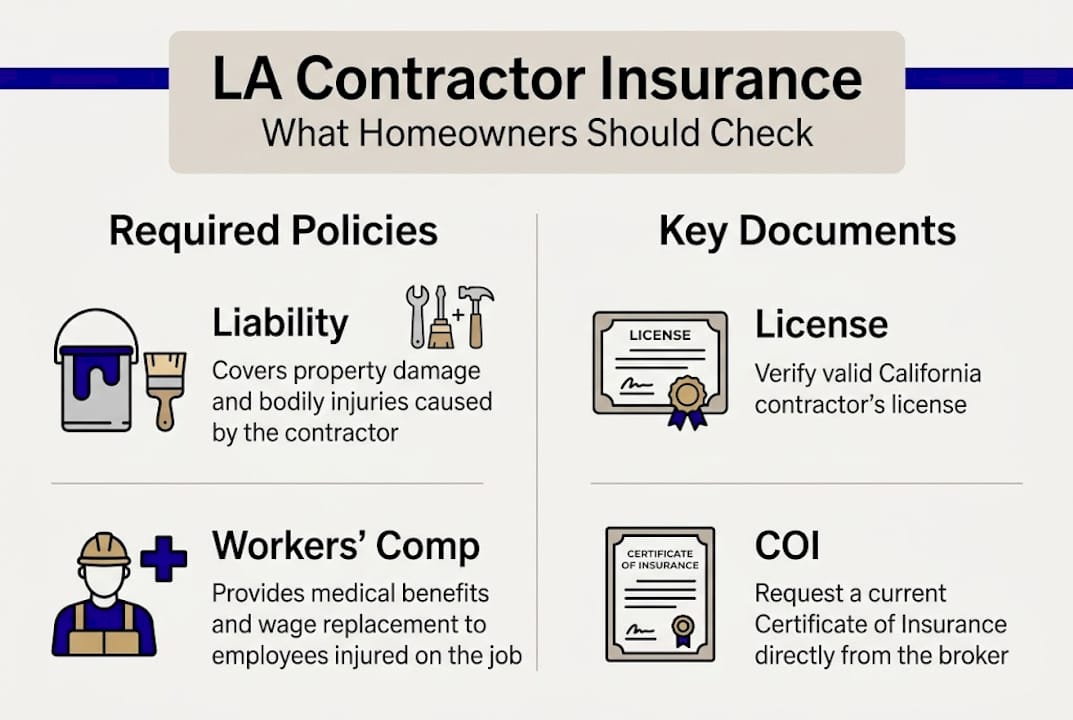
Here is a breakdown of the key policies:
Policy type | Typical coverage limit | Who it protects | Legal trigger |
General liability | $300K to $2M+ | Property owner, third parties | Required for C-33 license |
Workers’ compensation | Per state schedule | Injured workers | Mandatory with employees |
Inland marine | Varies | Contractor’s tools and equipment | Optional but recommended |
Commercial auto | $100K+ | Accident victims, property | Required if using work vehicles |
For residential projects, general liability coverage typically runs between $300,000 and $1 million. Commercial jobs usually demand at least $1 million per occurrence and $2 million in aggregate. High-rise or specialty work can push those limits even higher.
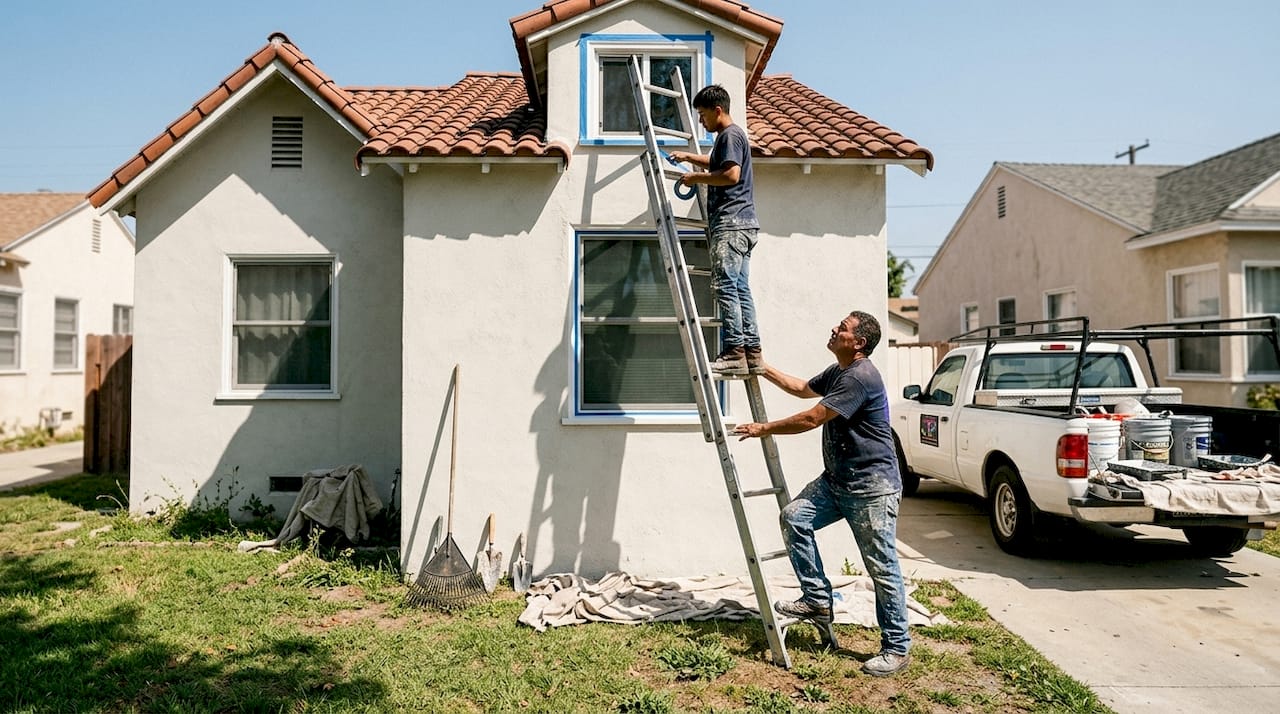
Employment status also changes the picture. Workers’ comp is mandatory for any employees, even part-time workers. Sole proprietors with no employees can file an exemption with the CSLB. Corporate officers can sometimes exclude themselves as well. But the moment a contractor hires even one helper, workers’ comp becomes a legal requirement, not a choice.
Here is how to verify coverage before signing anything:
Request a Certificate of Insurance (COI) directly from the contractor, not just a verbal promise.
Ask to be named as an additional insured on their general liability policy for your project.
Confirm the policy is current by checking expiration dates on the COI.
Verify the contractor’s CSLB license number at the state’s online portal to confirm active status.
Call the insurance company listed on the COI to confirm the policy is real and active.
Pro Tip: A legitimate contractor will hand over their COI without hesitation. If someone stalls, makes excuses, or offers a document that looks informal or hand-typed, treat it as a red flag. You can also check painter insurance requirements and insurance coverage explained for a deeper look at what each policy should include.
What insurance really protects: Risks, claims, and real costs
Knowing what insurance covers is crucial. Here is what is truly at stake if something goes wrong on your property.
Painting jobs look straightforward from the outside. But professional crews work with ladders, chemicals, and equipment in your living or working space. Accidents happen, even to experienced teams. Insurance protects margins from costly accidents, and California’s high-cost environment means premiums and claims run higher than the national average.
Consider a few realistic scenarios. A painter knocks over a five-gallon bucket onto a Persian rug. Replacement cost: around $8,000. A worker slips off a ladder and fractures a wrist. Medical and lost-wage costs: easily $15,000 or more. Overspray drifts onto a neighbor’s freshly detailed car. Repair bill: $2,500. Without insurance, every one of those costs lands on you or the contractor personally.
Here are the most common claim risks LA property owners face:
Paint or solvent spills on flooring, furniture, or landscaping
Ladder or scaffold falls causing worker injuries
Overspray damaging adjacent vehicles or neighboring property
Fire or chemical exposure from improper storage of flammable materials
Theft of contractor tools from your property, leading to project delays and disputes
“Uninsured contractors risk license suspension, fines up to $37,500, and personal liability.” This is not a hypothetical. The CSLB actively investigates unlicensed and uninsured work, and property owners who knowingly hire uninsured crews can face consequences too.
Pro Tip: When a bid comes in dramatically lower than every other quote, ask yourself why. Cutting corners on residential painting costs is one explanation. Skipping insurance is another. A contractor who carries no coverage has lower overhead, which lets them underbid legitimate competitors. That savings evaporates the moment something goes wrong.
Also worth knowing: a contractor’s claims history directly affects their insurance premiums. A crew with multiple past claims may carry higher-cost coverage or may struggle to get insured at all. That history is a signal about how carefully they work.
Special situations: Commercial jobs, lead paint, high-rise, and subs
Not all projects are alike. Certain jobs demand even more protection and due diligence.
Standard residential coverage is not always enough. Some projects trigger stricter requirements that go beyond the baseline C-33 policy. If your project falls into any of the categories below, you need to ask more pointed questions before work begins.
Lead paint and high-rise work require EPA RRP (Renovation, Repair, and Painting) certification and pollution liability coverage. High-rise or scaffolding jobs need higher limits or umbrella coverage on top of standard policies.
EPA RRP fines can reach $37,500 per violation. That is per violation, not per project. A contractor who skips certification on a pre-1978 home is not just cutting corners. They are exposing you to a federal enforcement action.
Here is what to verify for complex or high-stakes projects:
Confirm EPA RRP certification if your property was built before 1978 and any painted surfaces will be disturbed.
Request a higher-limit COI for commercial or multi-story work, with at least $1M per occurrence.
Ask whether the policy is occurrence-based or claims-made, since occurrence policies cover incidents that happen during the policy period even if the claim is filed later.
Verify that subcontractors carry their own insurance, not just the general contractor’s policy.
Check that the named insured on the COI matches the legal business name of the contractor you hired.
The subcontractor issue is especially important. If a general contractor brings in an uninsured sub and that worker is injured on your property, you and the general contractor can both be exposed. Reviewing LA painting contracts and the painting contractor FAQ can help you ask the right questions before signing anything.
Industry perspective: What most people get wrong about painting contractor insurance
Here is the uncomfortable truth that most articles skip: homeowners consistently prioritize the lowest bid over the safest hire. The assumption is that insurance is a background detail, something the contractor handles. But when a claim happens, you find out very quickly that it is your problem too.
We have seen it repeatedly over 16 years in the LA market. A property owner saves $400 on a bid, hires an uninsured crew, and ends up with a $12,000 dispute over damaged flooring and no legal recourse. The contractor disappears. The property owner is left holding the bill.
The deeper issue is that insurance liability tips rarely address the quality signal that insurance sends. A contractor who invests in proper coverage is also more likely to invest in proper surface preparation, which accounts for roughly 70% of a paint job’s long-term quality. Insurance and craftsmanship tend to travel together. A contractor who cuts corners on one usually cuts corners on the other.
If a contractor cannot show you a current COI within 24 hours of your request, move on. That is the simplest filter you have.
How to find an insured painting contractor you can trust in LA
Ready to put this advice into action? Here is how to choose a truly insured, experienced LA painting contractor.
Verifying insurance and licensing before hiring is not bureaucratic box-checking. It is the single most effective way to protect your property and your budget. At Johnny’s Custom Painting, we carry full general liability and workers’ compensation coverage and provide our COI to every client without hesitation.

You can view exterior residential projects and see interior commercial painting work directly on our site to evaluate quality before you call. When you are ready to move forward, contact Johnny’s Custom Painting for a detailed estimate along with full insurance documentation. We make it easy to hire with confidence.
Frequently asked questions
How can I verify a painting contractor’s insurance in Los Angeles?
Ask for a Certificate of Insurance listing you as additional insured, then confirm active coverage by checking the contractor’s CSLB license status online, which shows current insurance or exemption status.
What happens if I hire an uninsured painting contractor?
You can be personally liable for injuries or property damage on your property, and fines up to $37,500 plus license suspension can follow if the unlicensed or uninsured work is reported or investigated.
Are all painting contractors required to have workers’ compensation in California?
Yes, with one exception: workers’ comp is mandatory for all employees including part-time workers, but sole proprietors with no employees may file an exemption with the CSLB.
What insurance limits should I look for on commercial painting jobs?
Commercial projects require at least $1 million per occurrence and $2 million aggregate in general liability coverage, with higher limits required for high-rise, hazardous materials, or large-scale work.
Recommended
Comments