
Painting contracts for LA homeowners: what you must know
- Jonathan Hernandez
- Mar 25
- 9 min read


Many homeowners believe a handshake and verbal agreement suffice for painting projects, but this misconception exposes you to serious risks. Without a written contract, you have no legal recourse if materials differ from promises, timelines slip, or quality falls short. California law mandates written contracts for residential painting work exceeding $500, and these documents protect your property, finances, and peace of mind. This guide clarifies what constitutes a proper painting contract, why it matters for Los Angeles properties, and how to ensure your agreement covers scope, materials, warranties, and compliance with local environmental standards.
Table of Contents
Key Takeaways
Point | Details |
Written contract required | California requires written contracts for residential painting over $500 to define scope, materials, timelines, payments, and protections. |
Scope and materials detail | The contract must specify exact scope, surface preparation, number of coats, and cleanup to prevent misunderstandings. |
Payment terms and deposits | The agreement should set payment terms including deposits capped at $1,000 or 10 percent and a clear payment schedule. |
Liens and licensing protection | Include mechanics lien warnings and verify licenses and insurance to protect your property from unlicensed work and potential claims. |
Why painting contracts are essential for Los Angeles homeowners
California takes homeowner protection seriously. Painting contracts for residential work over $500 must comply with Business and Professions Code §7159, requiring written details on scope, materials, timeline, payment terms with deposits capped at $1,000 or 10% of the total cost, a three-day cancellation right, contractor licenses, insurance information, and mechanics lien warnings. These requirements exist because verbal agreements leave homeowners vulnerable to contractor disputes, substandard work, and financial loss.
Without a written contract, you cannot prove what was promised. If your painter uses cheap materials instead of the premium paint discussed, completes only one coat instead of two, or abandons the job midway, you have no legal documentation to enforce the original agreement. Written contracts create accountability and establish clear expectations for both parties.
Why proper contracts protect your property:
Define exact work scope including surface preparation, number of coats, and cleanup responsibilities
Specify material brands and types to prevent substitution with inferior products
Establish payment schedules that protect you from paying in full before work completion
Include mechanics lien warnings that safeguard your property ownership rights
Verify contractor licensing and insurance to avoid liability for unlicensed work
Mechanics lien warnings are particularly important. If a contractor fails to pay subcontractors or suppliers, those parties can place a lien on your property to recover payment. A proper contract includes notices about lien rights and protects you by documenting that you paid the contractor as agreed. Without this documentation, you could face double payment for the same work.
“Homeowners who rely on verbal agreements for painting projects risk losing thousands of dollars with no legal recourse. Written contracts are your only protection against contractor fraud, poor workmanship, and payment disputes.”
Choosing a professional painting service with proper contracts ensures you receive quality work backed by legal protections. Licensed contractors understand California regulations and provide comprehensive agreements that meet statutory requirements while protecting your interests.
Key components of an effective painting contract
Every painting contract should contain specific elements that clarify expectations, prevent misunderstandings, and ensure regulatory compliance. Understanding these components helps you evaluate whether a contractor’s agreement adequately protects your interests.
Essential contract sections:
Detailed scope of work description
Materials specifications with brand names and types
Project timeline with start and completion dates
Payment terms and schedule
Warranty coverage and duration
Change order procedures
Dispute resolution mechanisms
Termination clauses
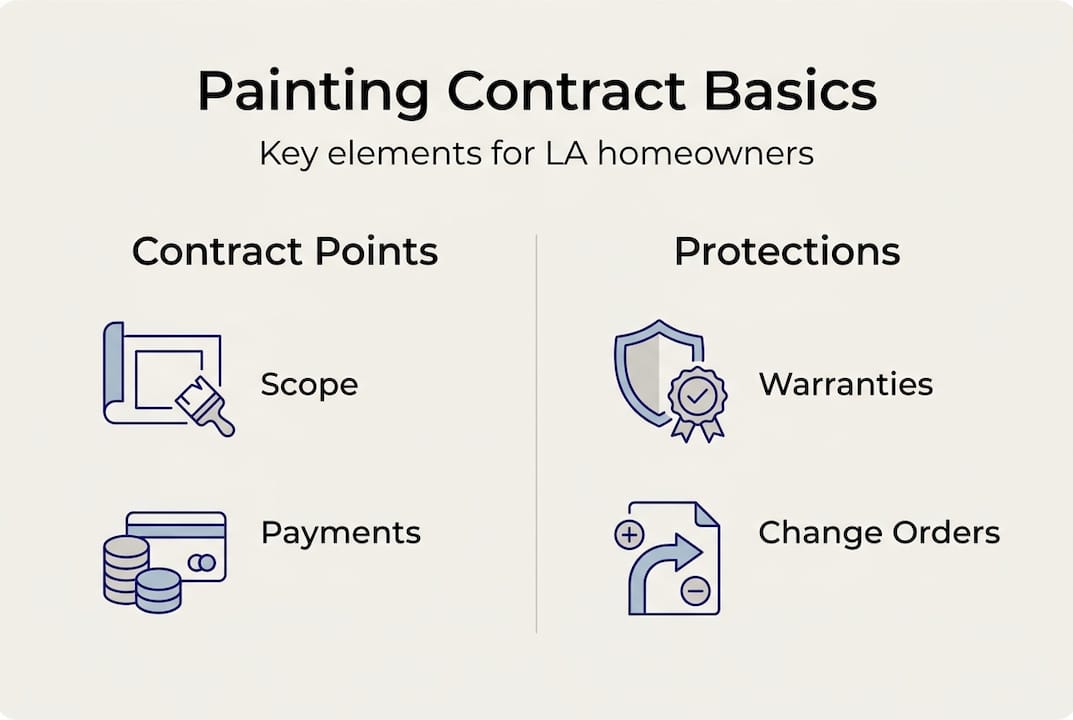
The scope of work, materials specifications, payment schedules, warranties, and change orders must be documented according to California regulations. Surface preparation often determines paint longevity more than the paint itself. Your contract should specify whether the contractor will repair cracks, sand surfaces, prime bare wood, or simply paint over existing finishes. Without these details, you might receive a quick cosmetic update that fails within months.

Materials specifications prevent contractors from substituting cheaper alternatives. Los Angeles environmental regulations require low-VOC paints in many applications, and your contract should name specific brands and product lines. If you agreed to Benjamin Moore Aura but receive a budget alternative, you have grounds to demand correction only if the contract specifies the original product.
Payment structure typically follows this sequence:
Initial deposit of 10-15% to secure scheduling and purchase materials
Progress payment after surface preparation completion
Second progress payment after primer application
Final payment upon project completion and your approval
Pro Tip: Never pay more than 10% upfront or agree to full payment before work completion. Legitimate contractors have sufficient cash flow to purchase materials and pay crews without demanding large advances.
Painting contract warranties vary significantly in coverage and duration. Quality contractors offer warranties covering both labor and materials for one to five years. Your contract should specify what the warranty covers, how long it lasts, and what actions void coverage. Some warranties exclude damage from improper maintenance or extreme weather, so read terms carefully.
Contract element | What to verify | Why it matters |
Scope of work | Specific tasks, number of coats, prep work | Prevents contractor shortcuts |
Materials | Brand names, low-VOC compliance | Ensures quality and regulatory compliance |
Payment terms | Deposit amount, milestone payments | Protects against contractor abandonment |
Timeline | Start date, completion date, weather delays | Sets realistic expectations |
Warranties | Coverage period, exclusions | Provides recourse for defects |
Change orders | Written approval process | Controls cost overruns |
Change orders document any modifications to the original agreement. If you decide to add another room or upgrade to premium paint, the contractor should provide a written change order detailing additional costs, timeline adjustments, and scope modifications. Verbal changes create disputes when memory differs about what was agreed.
Choosing professional painting services that provide comprehensive contracts ensures you receive clear documentation protecting your investment and establishing accountability throughout the project.
Navigating contract nuances: changes, cancellations, and compliance
Beyond basic contract elements, several nuanced provisions significantly impact your rights and protections. Understanding change orders, termination rights, and regulatory compliance helps you avoid common pitfalls that trap uninformed homeowners.
Change orders require written approval detailing scope, cost, and timeline adjustments under California law. Contractors cannot bill you for additional work without your documented consent. If your painter discovers rotted wood requiring replacement, they must provide a written change order specifying repair costs before proceeding. Verbal approvals offer no protection if disputes arise about pricing or necessity.
Termination rights protect both homeowners and contractors when circumstances prevent project completion. Valid termination reasons include client breach such as non-payment, unsafe site conditions like mold or lead contamination requiring specialized remediation, and force majeure events including natural disasters or government orders. Your contract should specify termination procedures, notice requirements, and payment obligations for completed work.
California limits mechanics liens on residential properties to projects exceeding $5,000, providing additional protection for smaller painting jobs. However, contractors can still pursue payment through small claims court or collections, so understanding your payment obligations remains critical. Withholding final payment until you verify work quality and completeness protects you from accepting substandard results.
Unauthorized work presents special challenges for property managers and landlords. If tenants arrange painting without owner approval, landlords can deduct costs from security deposits for unauthorized alterations. Your lease agreements should explicitly prohibit tenant-arranged painting to prevent disputes and ensure work meets your quality standards.
Contract clause | Protection provided | Common pitfall without clause |
Written change orders | Controls cost overruns | Surprise bills for extras |
Three-day cancellation | Allows reconsideration | Locked into bad agreements |
Termination for cause | Exit strategy for problems | Paying for incomplete work |
Mechanics lien notice | Property protection | Liens from unpaid suppliers |
Warranty terms | Quality assurance | No recourse for defects |
Dispute resolution | Avoids costly litigation | Expensive legal battles |
Pro Tip: Photograph all surfaces before work begins and after completion. Visual documentation proves pre-existing conditions and verifies work quality, supporting your position if disputes arise about damage or incomplete work.
Licensed painting services understand these nuanced requirements and provide contracts addressing change orders, termination rights, and compliance obligations. Their experience navigating California regulations protects you from common contract pitfalls while ensuring professional results.
How painting contracts ensure quality, compliance, and eco-friendliness
Properly structured contracts do more than prevent disputes. They guarantee quality outcomes, verify regulatory compliance, and ensure environmental responsibility that appeals to conscious Los Angeles homeowners and property managers.
Warranties provide your primary quality assurance mechanism. Contracts ensure quality through warranties and specifications, compliance through licensing and environmental standards, and eco-friendliness through low-VOC mandates while protecting against disputes with change and termination clauses. A five-year warranty on exterior painting demonstrates contractor confidence in their surface preparation, material selection, and application techniques. Contractors offering minimal or no warranties signal potential quality concerns.
Licensing verification protects you from unlicensed contractors who cannot legally perform work exceeding $500 in California. The C-33 painting contractor license requires examination, experience documentation, and financial responsibility. Licensed contractors carry insurance protecting you from liability if workers are injured on your property. Unlicensed contractors offer no such protection, leaving you vulnerable to lawsuits and workers’ compensation claims.
Contract provisions ensuring quality and compliance:
Contractor license number and verification instructions
Insurance certificates for liability and workers’ compensation
Low-VOC paint specifications meeting California Air Resources Board standards
Lead-safe work practices for pre-1978 homes
Warranty terms covering labor and materials
Quality standards for surface preparation and application
Los Angeles environmental regulations mandate low-VOC paints to reduce air pollution and protect public health. Your contract should specify paint products meeting these standards. Premium low-VOC paints perform as well as traditional formulations while minimizing harmful emissions. Contractors substituting non-compliant products violate both your contract and environmental regulations.
Lead-safe work practices are legally required for homes built before 1978. Contractors must be EPA-certified in lead-safe practices, contain dust during surface preparation, and dispose of waste properly. Your contract should document this certification and describe containment procedures protecting your family from lead exposure.
“Quality painting contracts protect homeowners through comprehensive warranties, verified licensing, environmental compliance, and detailed specifications. These provisions ensure professional results while safeguarding your health, property, and legal interests.”
Pro Tip: Before signing any contract, verify the contractor’s license status through the California Contractors State License Board website. Check for active status, proper classification, and any disciplinary actions. This simple step prevents hiring unlicensed or problematic contractors.
Partnering with a licensed and insured painting contractor who provides detailed contracts ensures you receive quality work meeting all regulatory requirements. Understanding painting warranties helps you evaluate coverage terms and select contractors standing behind their work with meaningful guarantees.
Get started with trusted painting contractors in Los Angeles
Now that you understand what constitutes a proper painting contract and why these protections matter, take action by partnering with reputable contractors who prioritize transparency and compliance. Johnny’s Custom Painting offers licensed, insured, and eco-friendly painting services backed by comprehensive contracts meeting all California requirements. With over 16 years of experience serving Los Angeles homeowners and property managers, they deliver quality results while protecting your interests through detailed agreements covering scope, materials, warranties, and environmental compliance.

Explore their interior residential painting portfolio showcasing completed projects demonstrating craftsmanship and attention to detail. Review their exterior residential painting portfolio to see how proper surface preparation and premium materials deliver lasting results. As a top-rated Los Angeles painting contractor, Johnny’s Custom Painting provides the detailed contracts and professional service you need for successful painting projects.
Pro Tip: Request sample contracts before committing to any painter. Reviewing their standard agreement reveals whether they understand California requirements and prioritize homeowner protection through comprehensive documentation.
FAQ
What is the role of a painting contract for a homeowner?
A painting contract establishes legal protections by defining work scope, specifying materials and quality standards, scheduling milestone payments, and outlining dispute resolution procedures. It ensures compliance with California regulations including contractor licensing, insurance requirements, environmental standards, and mechanics lien protections. The contract safeguards your financial interests by limiting deposits, guaranteeing cancellation rights, and documenting warranties. For more details, visit our painting contract FAQs.
What should a homeowner look for in a painting contract?
Look for clear descriptions of work scope including surface preparation, number of coats, and cleanup responsibilities. Verify material specifications naming brands and confirming low-VOC compliance. Check payment terms limiting deposits to 10% or $1,000 maximum. Confirm warranty coverage for both labor and materials. Ensure the contract includes contractor license numbers, insurance certificates, and mechanics lien warnings. Review painting warranty types to understand coverage options.
Can a homeowner cancel a painting contract after signing?
Homeowners have a three-day right to cancel contracts without penalty under California law. This cooling-off period allows you to reconsider your decision and withdraw from the agreement. Beyond the three-day window, termination clauses may allow cancellation for cause including contractor breach, unsafe site conditions requiring specialized remediation, or force majeure events. Review your contract’s termination provisions to understand your rights and any associated costs for canceling after work begins.
Why is contractor licensing important in painting contracts?
Licensed contractors demonstrate compliance with California safety and quality standards through examination, experience verification, and financial responsibility requirements. The Contractors State License Board enforces penalties on unlicensed work to protect consumers from fraud and substandard workmanship. Unlicensed work risks voiding your contract, leaving you without legal recourse for poor results. You also face potential liability for worker injuries since unlicensed contractors rarely carry proper insurance. Choose licensed and insured painting services to protect your interests and ensure professional results.
Recommended
Comments